
The Aztec civilization was the Mesoamerican culture inhabiting central Mexico in the post-classic period from 1300 to 1521, when the Spanish began to settle the area in the 16th century. The Aztecs, like other Mesoamerican cultures, brewed and consumed several fermented alcoholic drinks made from various indigenous plants.
One interesting and (in my opinion) delicious pre-Hispanic beverage, known as pulque, has a rich history associated with Aztec sacred spiritual beliefs as well as secular con-sumption and regulation in Aztec society.
First brewed February 26, 2022 for the Royal Brewer Competition, Kingdom of Atlantia, SCA Inc.
Background
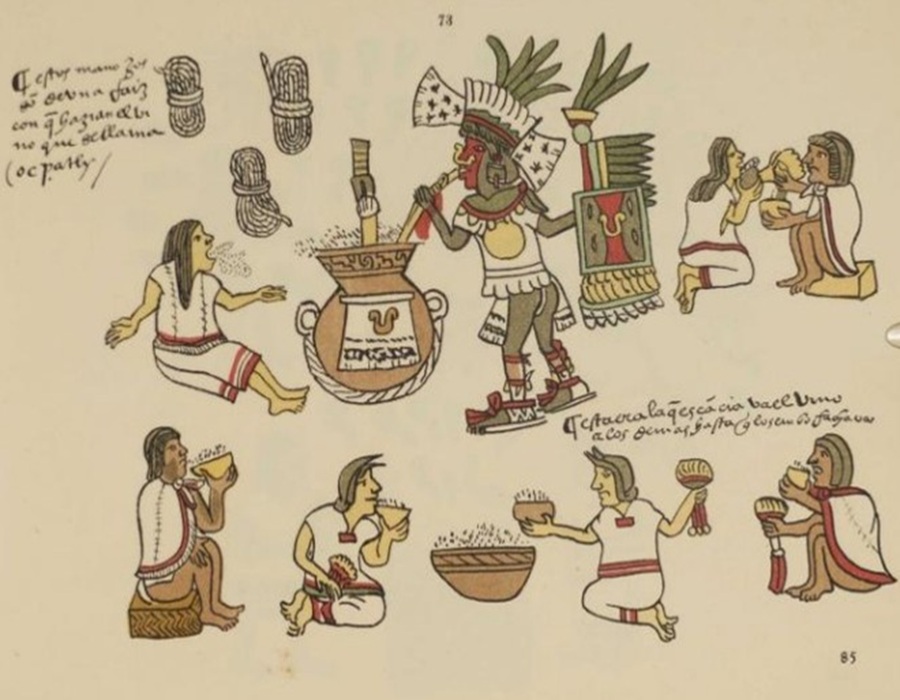
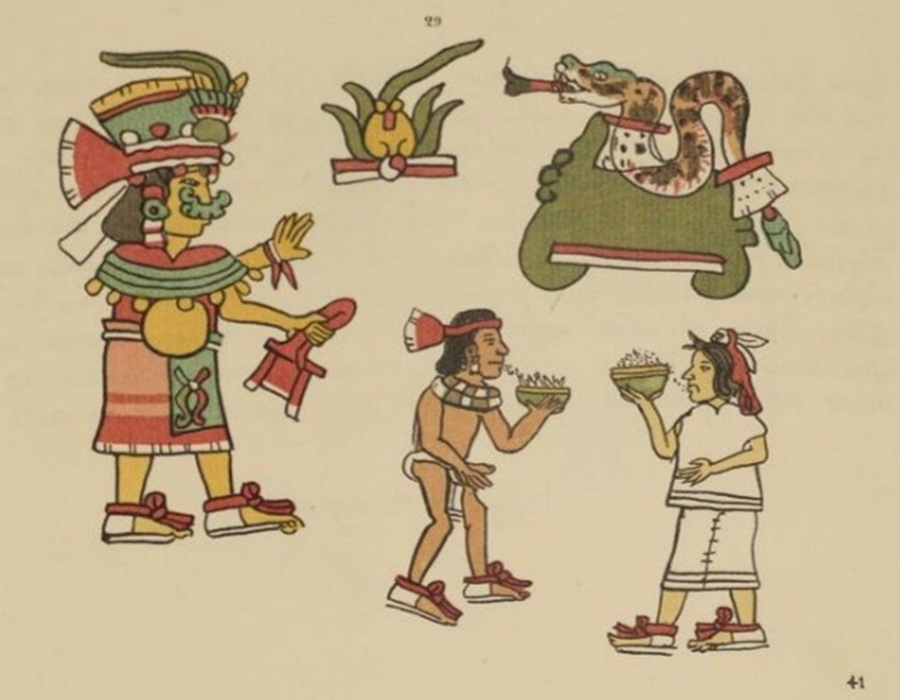
When the Spanish landed in Mexico in the sixteenth century, they found people who had been fermenting and consuming various beverages, the most common being pulque. From Spanish chroniclers such as Bernardino de Sahagun, we learn that the Aztecs held community celebrations regularly, and both indigenous and Spanish depictions show people at all levels of society consuming pulque. Pulque was an important element of religious celebrations. Aztec priests regularly performed human sacrifices, and interestingly, both priests and their sacrifices partook of the drink. Fortunately for most, drinking pulque was not limited to those particular ceremonies.1
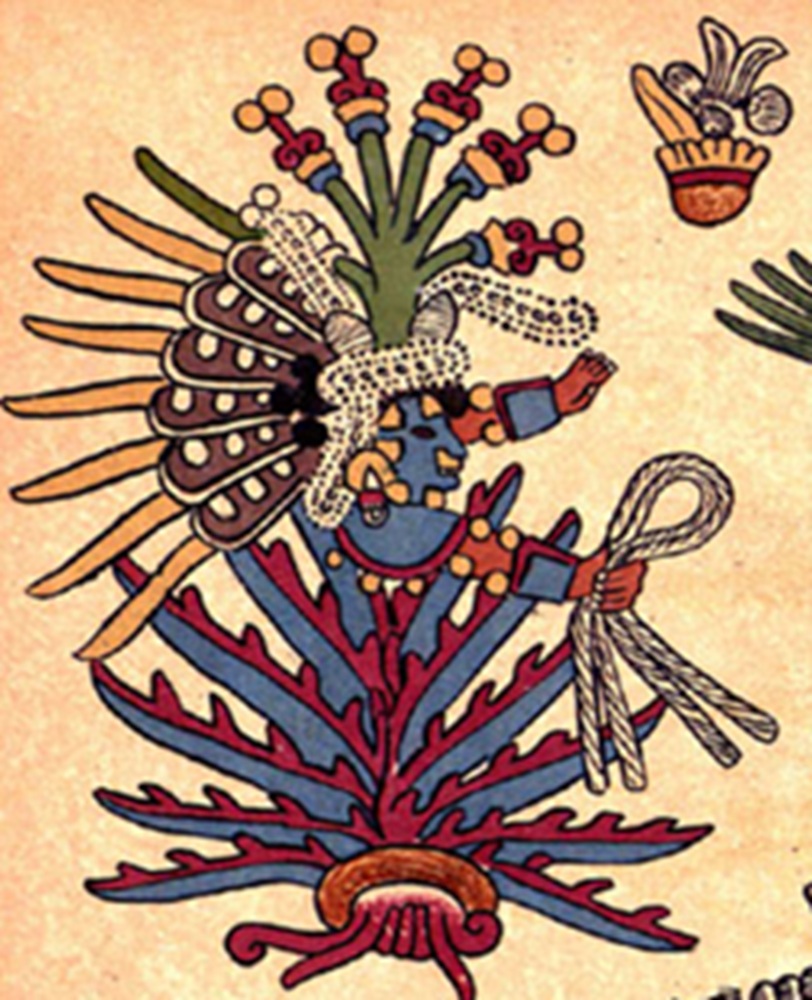
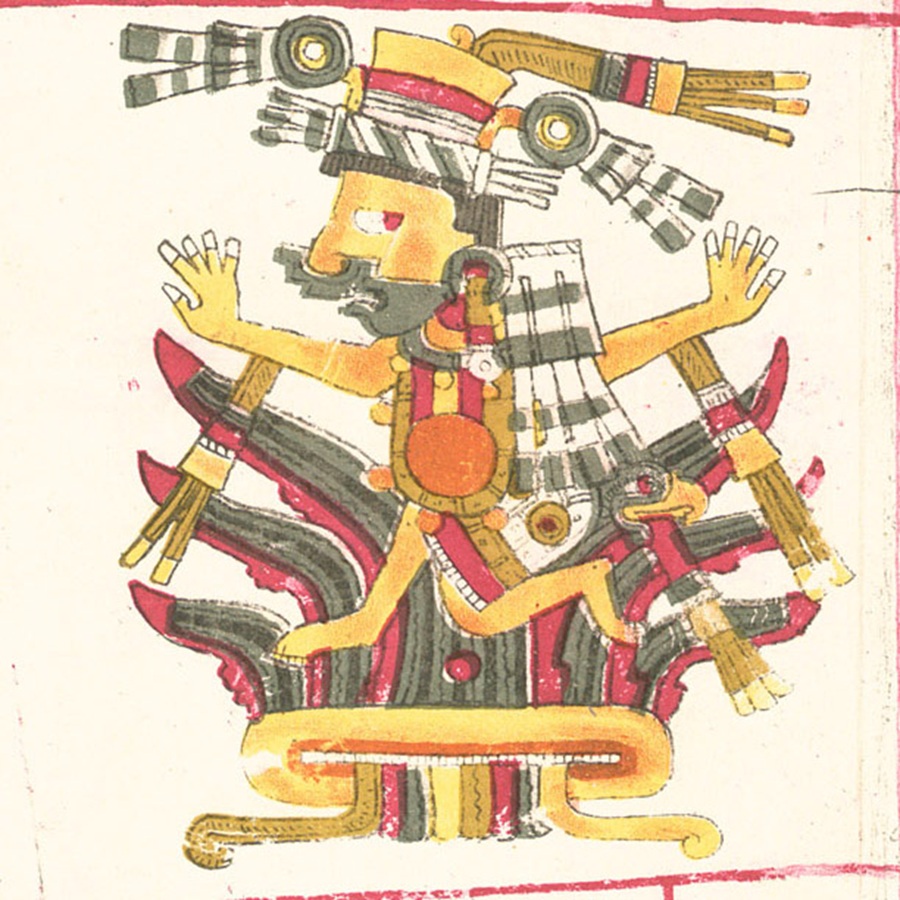
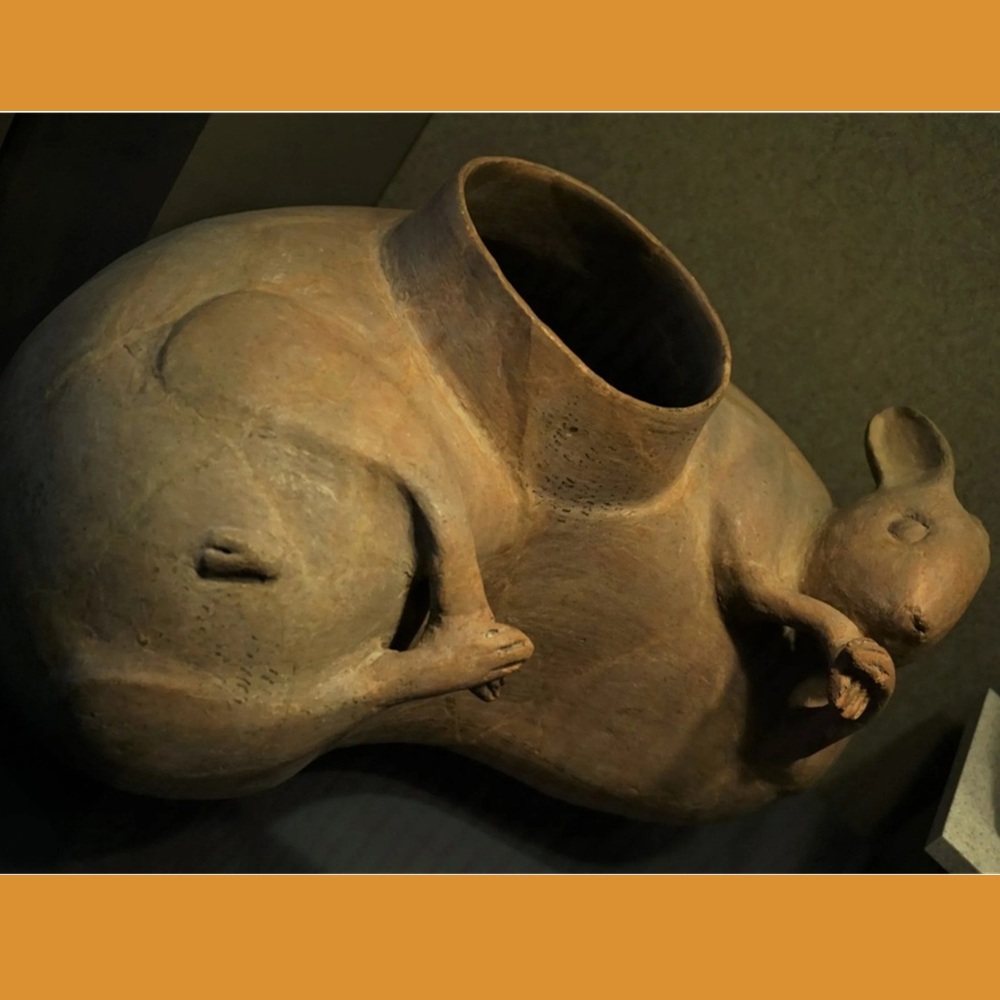
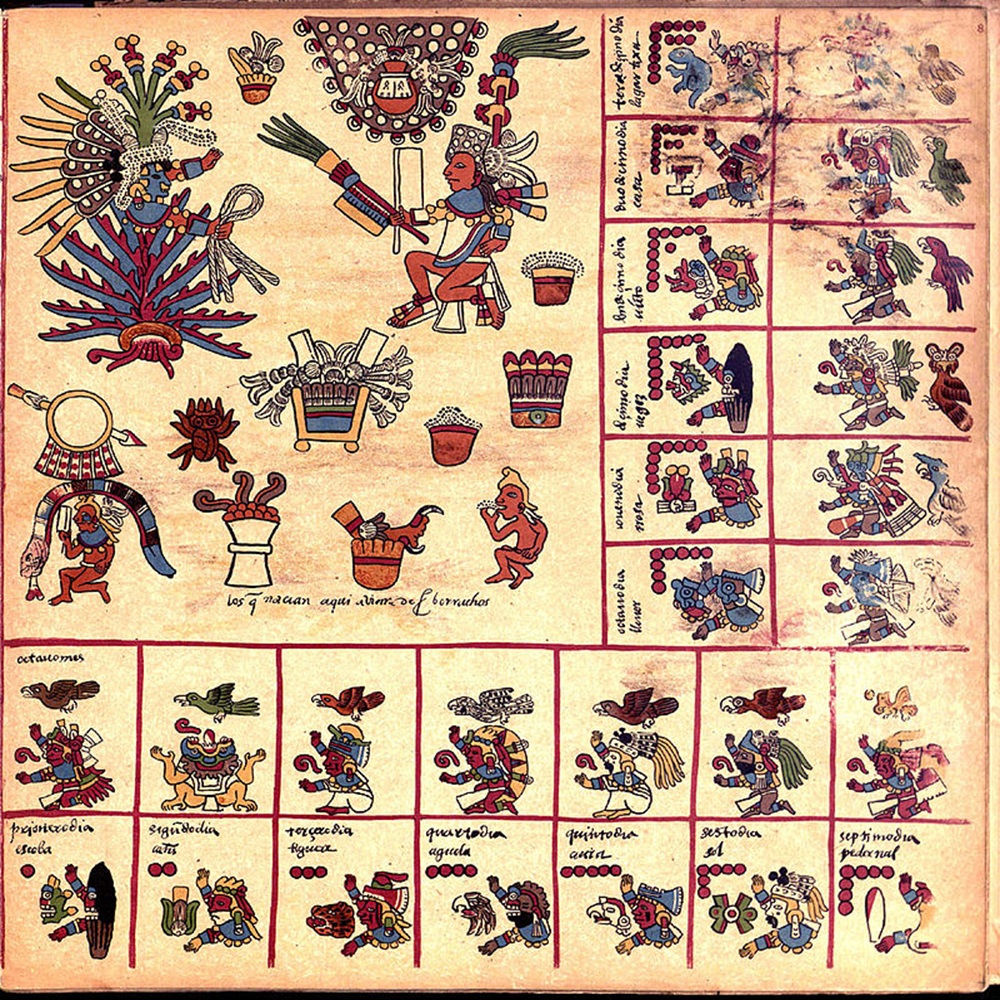
Aztec mythology says that the Aztecs regarded pulque as the ‘Milk of the Mother’ because it was a gift from Mayahuel, the divine Goddess2. Mayahuel is considered the spirit of the agave plant and the goddess of the drink pulque itself. A very busy goddess, Mayahuel had 400 children, known as the 400 Rabbits, or Centzon Totochtin, who were gods of drunkenness, thus pulque personified. The collective group of gods around pulque were known as the Ometochtli3, or ‘Two Rabbits’, sometimes known as the gods of excess. From depictions of the time, drinking pulque to excess seemed common!
So What is Pulque?
Pulque is often described as a ‘milky’ colored beverage made from fermenting the sweet sap, called aguamiel, of certain varieties of agave (called maguey by the Spaniards)4, with other grains, fruits and botanicals. Pulque contains about 5% alcohol by volume (ABV). There are several versions of pulque depending on the additives, such as white pulque (agave only), blue pulque (made with blue or purple corn), pulque curado5 (made with fruit additives), and five-fold, or sacred pulque (Mc Govern, 147).
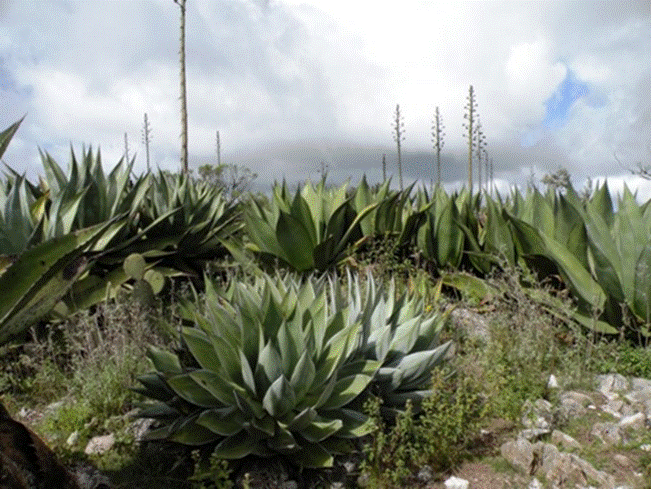
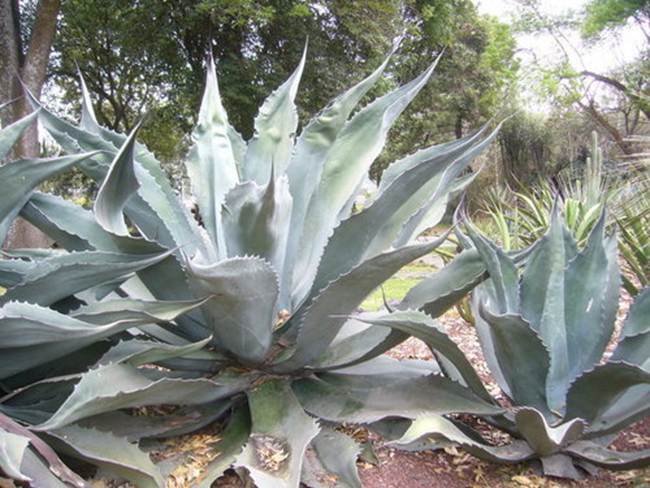
Agave plants, used to brew pulque were species found in the area where the pulque batch was brewed. Common varieties included the massive Agave atrovirens, called pulque agave, and Agave salmiana6. Because agave cacti were considered a gift from the goddess Mayahuel, the plants were tended carefully. The long and complex process of extracting the sap was both agricultural and spiritual in nature.7
The plant is surprisingly productive, making large quantities of sugary sap over the course of its life. According to Rod Phillips, a large agave plant could yield 4 to 7 liters of sap per day and produce up to a thousand liters of pulque before it died. A large field of agave could produce a considerable amount of pulque8.
Plant materials influenced, or were added to, pulque which would produce strong flavors, like the smoke from fires used to dry the corn during the malting process. There is no evidence (so far) indicating that botanicals were added specifically as a preservative, unlike in Europe and other areas during the same period, where plants like hops were added for preservation but had a profound effect on flavor.
Pulque was, however, mixed with fruit, herbs, roots, peppers, and more exotic additives which increased the effects of pulque on the drinker to almost hallucinogenic. Spanish authorities were alarmed by this and attempted to regulate the production of pulque by 1529, and issued edicts against mixing pulque with other substances, but were unable to discover what those additives were.9
Unlike beer, wine, and other familiar fermented beverages in which yeast is the microbe acting upon the sugars, pulque’s fermenting agent is the bacteria Zymomonas mobilis, which occurs naturally on the skins of agave and other tropical plants of the region and performs yeast-type fermentation of carbohydrates to ethanol.10
Pulque was served while still fermenting and, with the lack of antiseptic plants, was intended to be drunk quickly. Once fermentation has begun, the pulque does not stop until the drink is unpalatable. After the arrival of the Spanish, attempts were made by the invaders to limit production of pulque to allow more importation of alcohol from Spain.
One Spanish account from 1552, attributed to Francisco López de Gómara, suggests that within a few days after production, pulque takes on a ‘smell worse than that of a dead dog’. Thus, the short life of pulque made it an ideal drink for holidays and celebrations but was only drinkable when fresh.
The Project
To recreate an Aztec pulque-style beer, I turned to several books and internet resources to get a feel for the general conditions and the style. The most complete recipe I found was created by Dr. Patrick McGovern in “Ancient Brews Rediscovered and Recreated.” Since his work is based on chemical and physical analysis of remains and closer to the original, I think his ingredient selection will more closely approximate what was used in period.
There are two methods presented; the first uses a “chew and spit” traditional chicha method to get enzymes working on the purple corn11. While this is a very period appropriate process, and has been used many times in modern settings, I decided to proceed with the modified process which eliminates the “chew and spit” method. While the method is proven safe, I did want to create a drink here that I can confidently say does NOT contain saliva at any stage of the process.
To simulate the result of using the chicha method, I purchased some malted purple corn known as “bloody butcher”. Since malting activates enzymes, I think this tracks for that aspect of the project.
I had considered using amylase enzyme to start a starch conversion of the corn, but I was fortunate to find the purple corn in an already malted form. In other words, it was already processed in a manner similar to what the chew and spit method would have achieved.
I also decided not to bottle, since accounts in the aforementioned references state that the drink was a week old, and when served, it was foaming.
I surmised from this that the traditional period way of serving pulque is during primary fermentation.
Expected Yield: Five gallons of 8.5% alcohol beer (starting gravity should be around 1.065). While I had multiple batches achieve the predicted specific gravity, the current batch produced a starting gravity of 1.052 (7.0% potential) which was lower than my previous attempts, but is more in line with Dr McGovern’s prediction.
Ingredients
1 pound Purple Corn (Bloody Butcher malt)
½ pound Dried Guava (substituted 12 oz of Guava Nectar)
½ pound Fresh Prickly Pear cactus
1 teaspoon Pectic Enzyme
3 each Fresh jalapeno
2 Tbs Gypsum
1 pound Brewer’s Malt (Used 2 row barley)
¼ pound Caramel malt, 40-degree Lovibond
¾ pound Cherrywood smoked malt
5 ½ pounds Agave syrup
1 ½ pounds Blue corn syrup (substituted Chicha Morada Purple Corn Drink)
1 ounce Mesquite powder (used mesquite wood chips instead)
1 packet Lallemand Belle Saison yeast
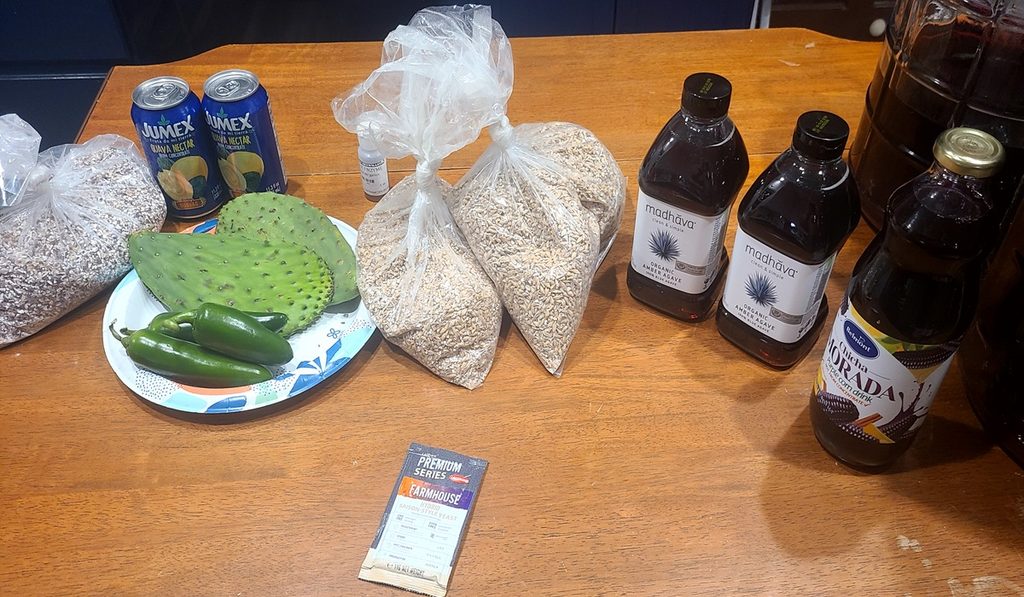
While I was not able to obtain all the ingredients, I got almost everything (except dried guava), and hopefully this will be enough to provide a good representation of the drink.
It should be noted that for my first batch, the original gravity turned out to be 1.064, slightly lower than expected. As I have continued making this drink, my original gravity is starting lower (I may be using more water in the carboy for primary fermentation).
The second batch measured similarly at 1.065; the third batch was at 1.068 with nearly 9% potential. Since it is served while still fermenting, the drink as consumed should be somewhat lower in alcohol than that. The measurement the day before serving (March 3, 2023) was 1.030, or 4.99% ABV.
The current batch for presentation started at 1.052 (7.0% potential) and finishes the day before serving at 1.018 (2.5% potential), so it is being served at slightly above
The Process
Step 1: Place the dried guava in a bowl and cover with 1 gallon of water to soak (since I was using Guava nectar, the juice was poured into a bowl by itself).
Step 2: A day later, add the prickly pear to the guava and puree them together. Add the pectic enzyme and allow it to sit overnight. This significantly emulsifies the prickly pear cactus from a rubbery consistency into a liquid.
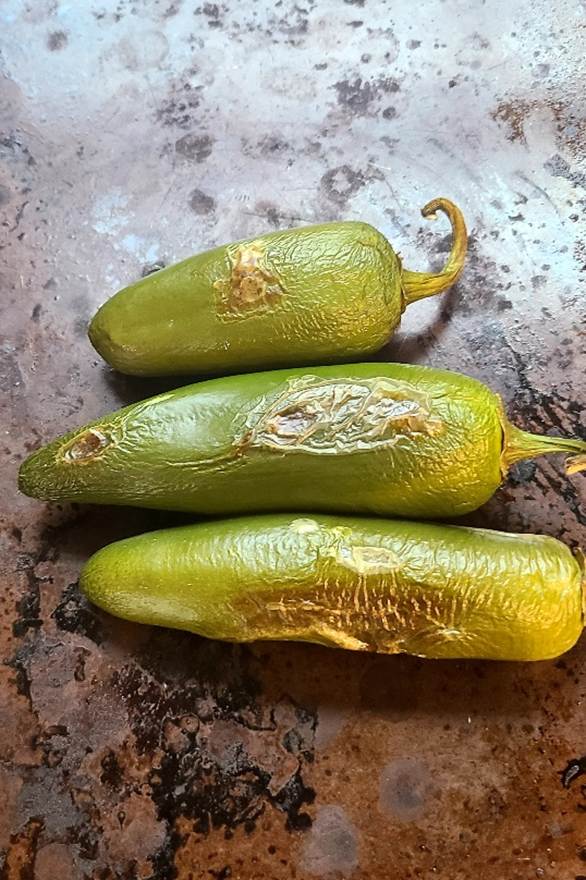
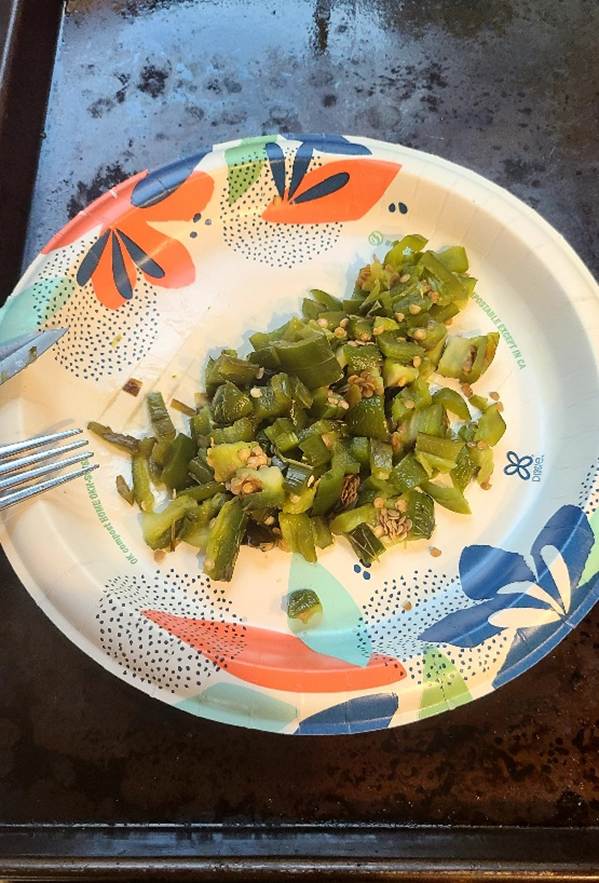
Step 3: On the third day (brew day), grill the jalapenos and dice them finely.
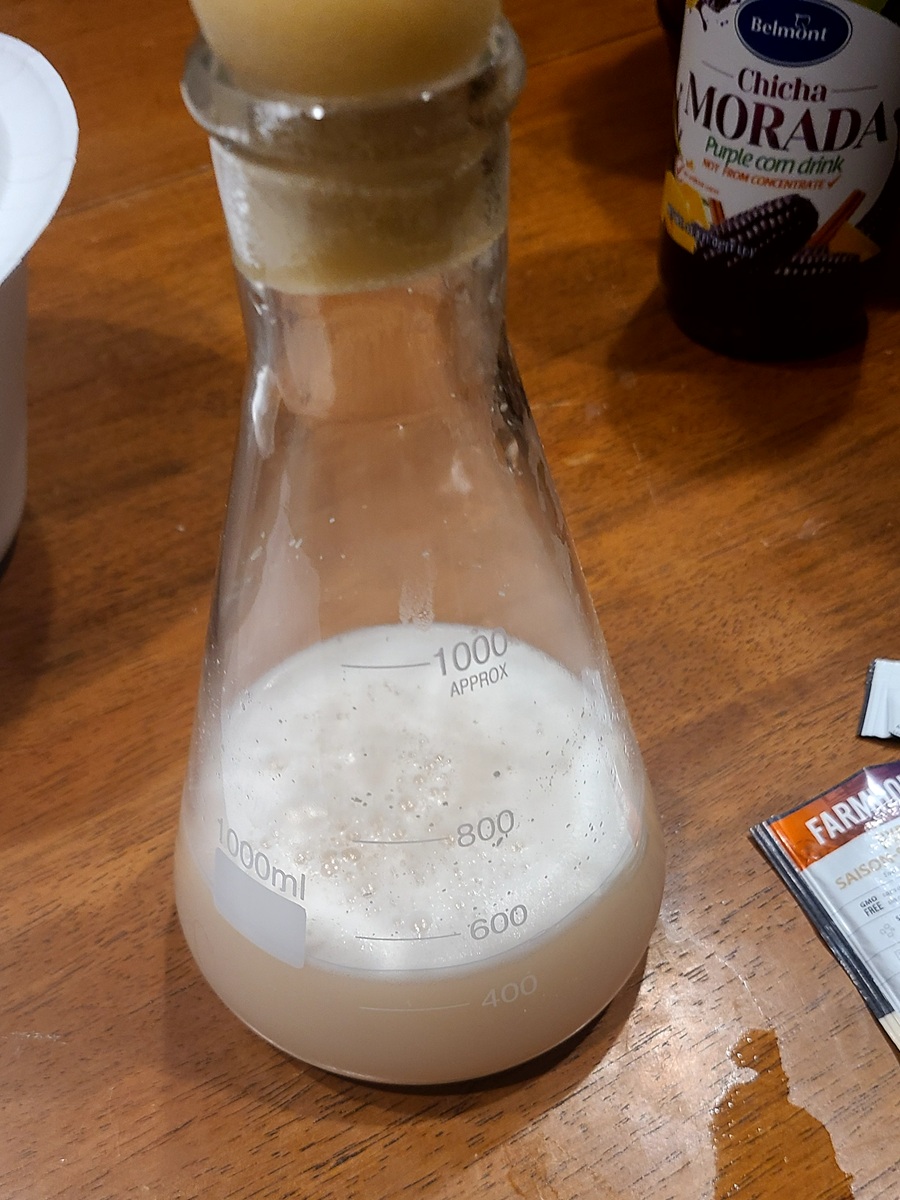
Step 3a (yeast starter): Concurrently with jalapeno dicing, start the yeast. Pour the dry yeast into 400 mL of clear water for the initial rehydration. After about 15 minutes, add yeast nutrient and a small amount of sugar. This will encourage the yeast to be ready for reproduction to allow a healthy yeast colony to consume much of the sugars quickly, in order to minimize risk of infection.
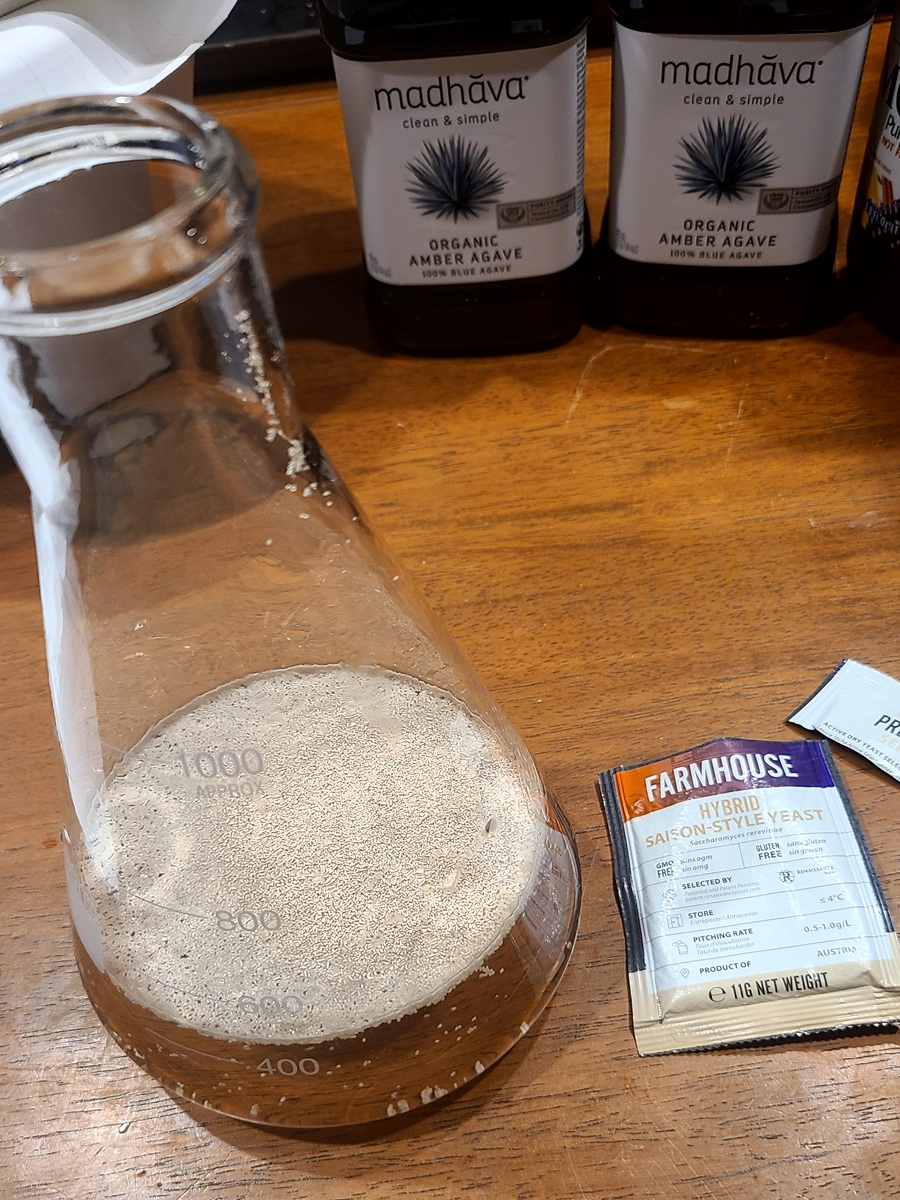
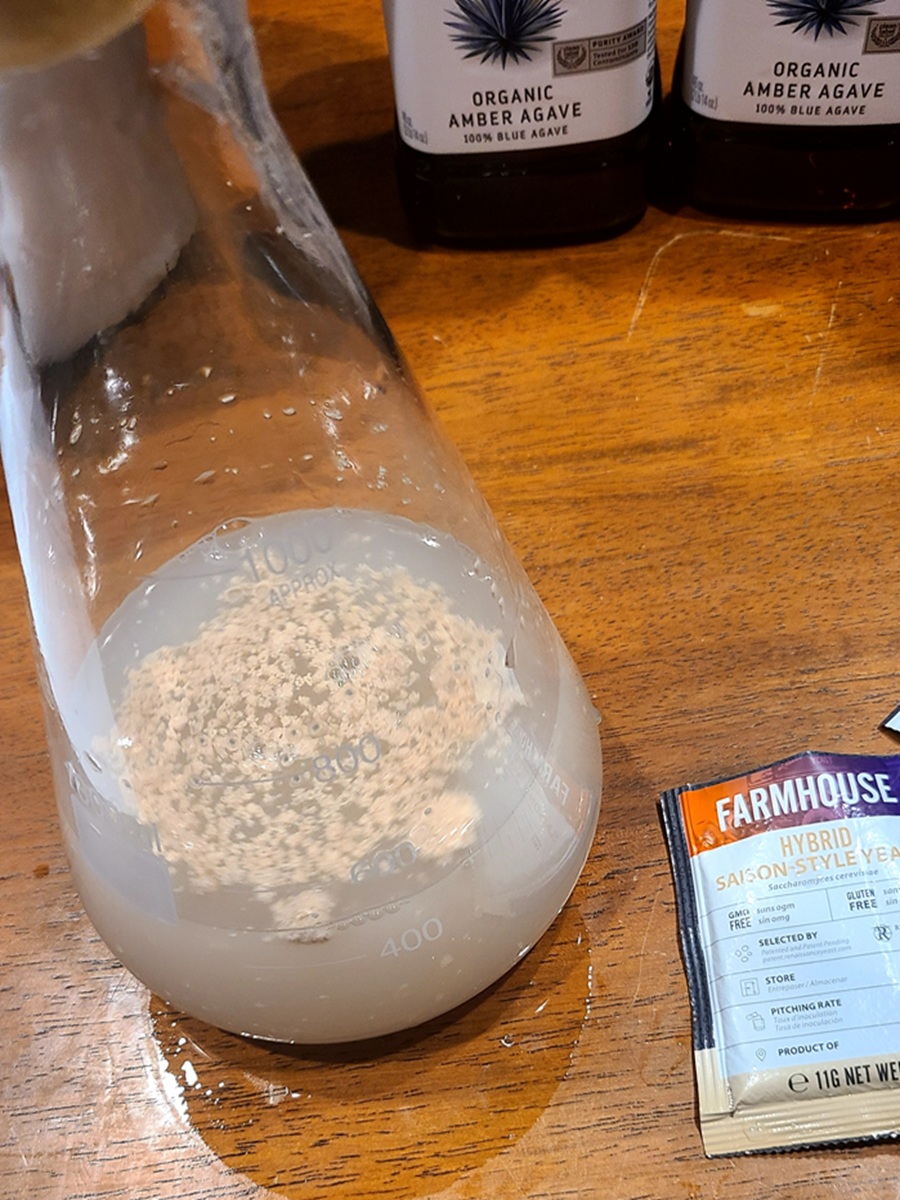
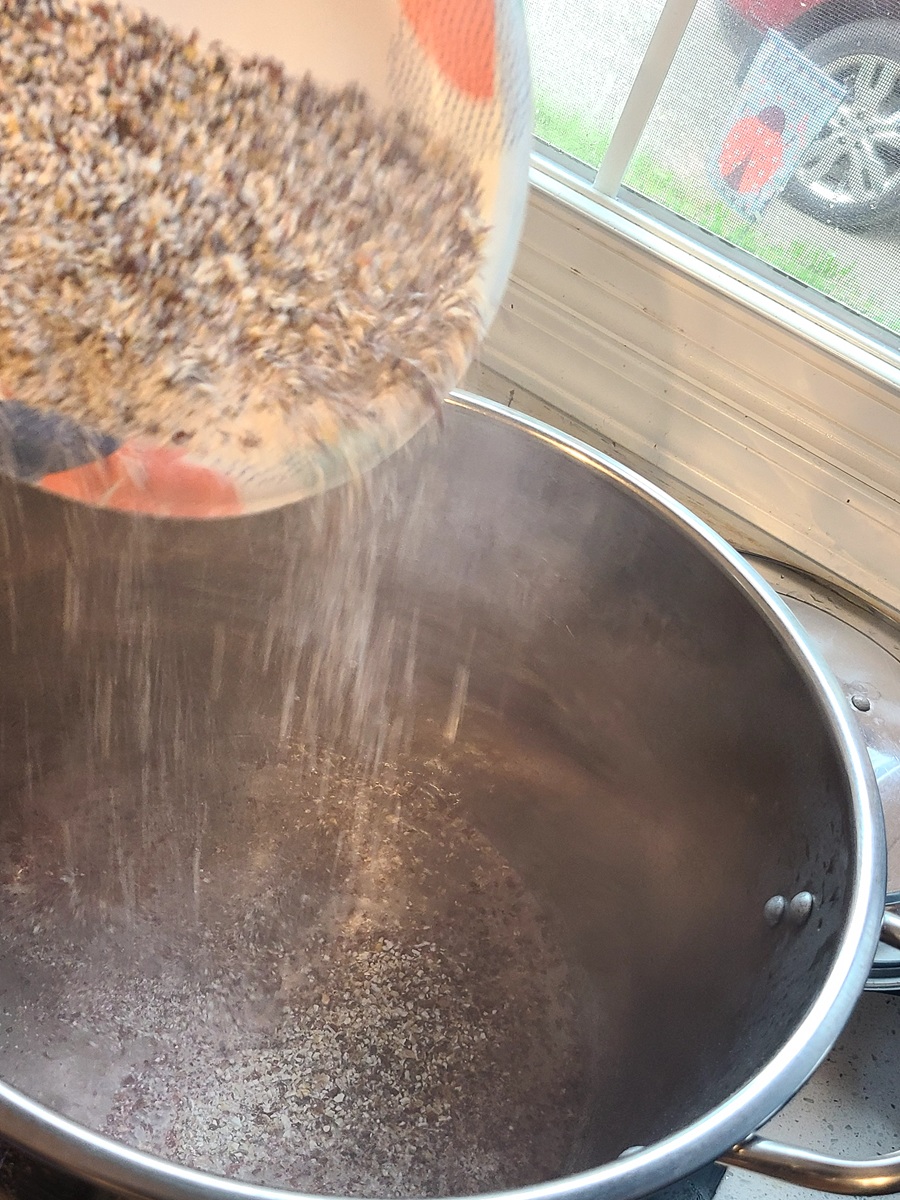
Step 4:In a pot, bring 2 quarts of water to a boil, remove from heat, and add the crushed malted corn and gypsum. Simmer 20 minutes, stirring to prevent corn from sticking.
Step 5: Add 1-pint cold water to the corn mixture, then add the crushed malts and stir. Adjust the temperature to 122 degrees by adding colder or hotter water for ten minutes (this is a protein rest). I added more water to the mixture in order to allow the starch (and sugars) to dissolve more fully. My temperature varied from approximately 125 degrees down to 117 degrees, close to the desired temperature. I believe this step is not related to anything in period, but a reflection of our understanding of how to maximize sugar production from modern malted grains.
Step 6: After the protein rest, raise the temperature to 140 to 145 degrees and hold for thirty minutes (this allows a more complete starch conversion). While the corn and malt mixture are resting, put 4 gallons of water in a brew pot and heat to 170 degrees.
Step 7: After the 30-minute starch conversion rest, spread a grain bag over the container holding the grains and pour the hot water into the brew pot (through the grain and grain bag). Use the grain bag like a teabag, and bounce it in the hot water to dissolve the sugars into the solution. Then hold the grain bag up and allow the water to drain without squeezing the bag. Discard the grain and the bag.
*note: I kept the bag because it is reusable. I soak the bag in cleaning solution to sanitize it before use.
Step 8: Turn up the heat to bring the solution near boiling, then remove from the heat.
Step 9: Add agave syrup and bring to a boil, for 25 minutes.
Step 10: Add the Blue corn syrup and the guava/prickly pear/pectin mixture. The Mesquite chips were also added at this point. Add the diced grilled jalapeno. Boil for 5 more minutes.
Step 11: Cool mixture to 75 degrees and transfer to a fermenter. Top up to 5 gallon mark.
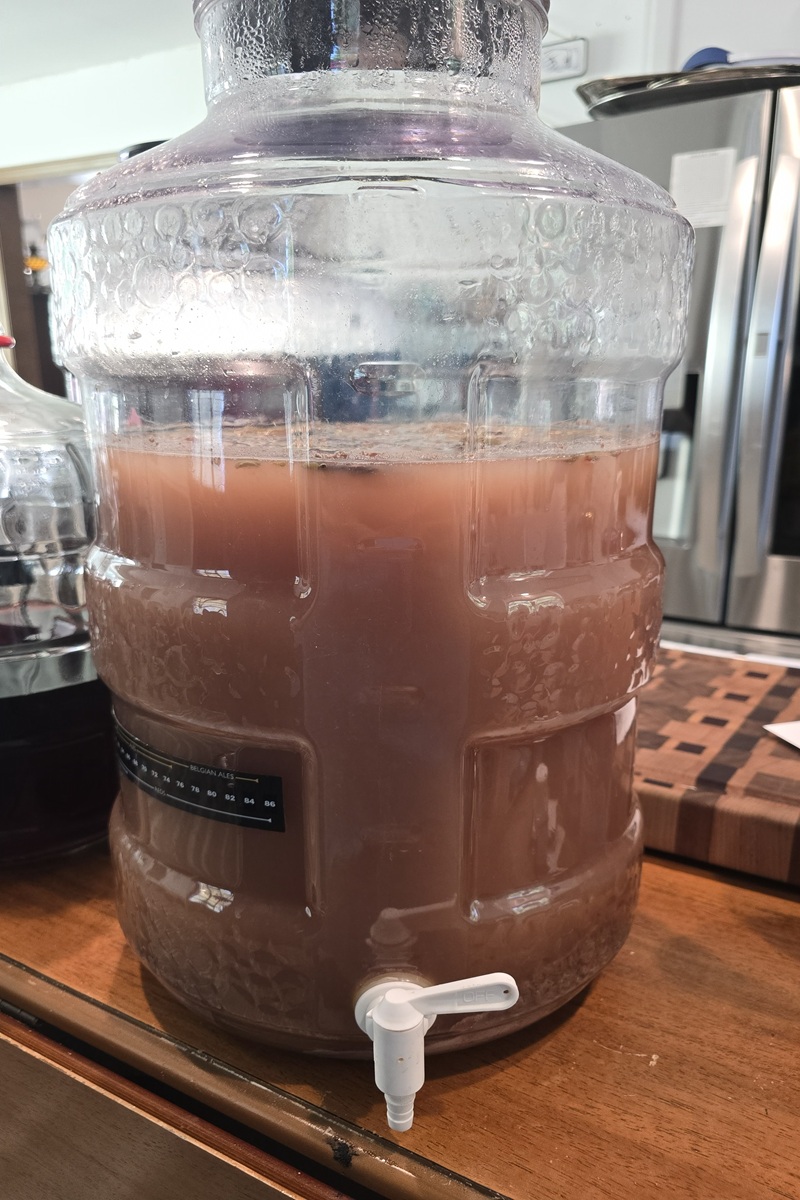
Step 12: Pitch yeast and begin primary fermentation. This should begin a vigorous primary fermentation within three to four days, in time to serve. I added Fermax yeast nutrient, proofed the yeast, and pitched a starter. Within 8 hours, bubbles were observed at the surface.
The original instructions call for additional steps for bottling and aging, but I am serving it here in the traditional fashion during primary fermentation.
Conclusion
The expected flavors are all present and the drink (still very sweet) is pleasant. The aroma of Jalapeno without the heat provides a very good flavor balance. The color, a bit pink, is from the purple corn drink, and possibly the guava nectar, whereas the documents of the time describe pulque as being white and milky. The texture is enhanced by the pectin-reduced cactus, an interesting and surprising addition.
Aside from the color, and given the wide variety of botanicals available as additives in period, I think this project is successful at representing what a pulque could have been like in year 1520.
Footnotes
- McGovern, Patrick E. Ancient Brews: Rediscovered and Re-created. New York: W. W. Norton & Company, 2017. P147 ↩︎
- Buhner, Stephen Harrod. Sacred and Herbal Healing Beers: The Secrets of Ancient Fermentation. Boulder, CO: Brewers Publications, 1998. Pp 90-93 ↩︎
- Phillips, Rod. Alcohol a History. Chapel Hill: University of North Carolina Press, 2014. 137. ↩︎
- Stewart, Amy. The Drunken Botanist: The Plants that Create the World’s Great Drinks. Chapel Hill: Algonquin Books of Chapel Hill, 2013. 2 ↩︎
- Ibid., 4. ↩︎
- Bruman, Henry J. “Alcohol in Ancient Mexico”. Salt Lake City: The University of Utah Press, 2000. 68 ↩︎
- Buhner, 90. ↩︎
- Phillips, 136 ↩︎
- Ibid., 137 ↩︎
- Stewart, 4 ↩︎
- McGovern, Patrick E. Ancient Brews: Rediscovered and Re-created. New York: W. W. Norton & Company, 2017. P253 ↩︎
Full Bibliography
Books
Buhner, Stephen Harrod. Sacred and Herbal Healing Beers: The Secrets of Ancient Fermentation. Boulder, CO: Brewers Publications, 1998.
De Sahagún, Bernardino. Florentine Codex: General History of the Things of New Spain. Translated by Arthur J. O. Anderson and Charles E. Dibble. 13 vols. Santa Fe and Salt Lake City: School of American Research and University of Utah Press, 1950–1982. 52, 60, 95, 106, 110
McGovern, Patrick E. Ancient Brews: Rediscovered and Re-created. New York: W. W. Norton & Company, 2017.
McGovern, Patrick E. Uncorking the Past: The Quest for Wine, Beer, and Other Alcoholic Beverages. Berkeley: University of California Press, 2009.
Oliver, Garrett, ed. The Oxford Companion to Beer. Oxford: Oxford University Press, 2011.
Phillips, Rod. Alcohol: A History. Chapel Hill: University of North Carolina Press, 2014.
Stewart, Amy. The Drunken Botanist: The Plants that Create the World’s Great Drinks. Chapel Hill: Algonquin Books of Chapel Hill, 2013.
de Sahagún, Bernardino. Florentine Codex: General History of the Things of New Spain. Translated by Arthur J. O. Anderson and Charles E. Dibble. 13 vols. Santa Fe and Salt Lake City: School of American Research and University of Utah Press, 1950–1982. 52, 60, 95, 106, 110
Biblioteca Nazionale Centrale di Firenze, Codex of Magliabechiano, formally The Book of the Life of the Ancient Mexicans: Containing an Account of Their Rites and Superstitions, intro. and ed. Zelia Nuttall (Berkeley: University of California, 1903), Internet Archive. https://archive.org/details/booklifeancient00boongoog.
Articles
A. Escalante et al., “Pulque, a Traditional Mexican Alcoholic Fermented Beverage: Historical, Microbiological, and Technical Aspects,” Frontiers in Microbiology 7 (2016), https://pmc.ncbi.nlm.nih.gov/articles/PMC4928461/.
Á. E. Rubio-Castillo et al., “Tejuino, a Traditional Fermented Beverage: Composition, Safety, Quality, and Microbial Identification,” Foods 10, no. 10 (2021), https://pmc.ncbi.nlm.nih.gov/articles/PMC8535997/.
Aasved, Mikal John. “Alcohol, Drinking, and Intoxication in Preindustrial Society: Theoretical, Nutritional, and Religious Considerations.” Dissertation, Ann Arbor, Mich: UMI, 1991. 782
Adelfo Escalante et. al.,“Pulque Fermentation,” in Handbook of Plant-Based Fermented Food and Beverage Technology, ed. Y. H. Hui (Boca Raton, FL: CRC Press, 2012), 691–706.
“Ancient Mexican Mural Depicting Drunken Revelry Revealed for the First Time.” Ancient Origins. June 24, 2014. Read January 05, 2026. http://www.ancient-origins.net/news-history-archaeology/ancient-mexican-mural-depicting-drunken-revelry-revealed-first-time-001754.
C. Ojeda-Linares et al., “Traditional Fermented Beverages of Mexico: A Biocultural Unseen Foodscape,” Foods 10, no. 10 (2021), https://pmc.ncbi.nlm.nih.gov/articles/PMC8535898/.
Dylan John Leach, “Mural of the Drinkers,” HistoricalMX, accessed April 17, 2026, https://historicalmx.org/items/show/26.
Museo de América, Madrid, Tudela Codex [Códice Tudela], mid-16th century manuscript, ca. 1540–1554, description by Juan José Batalla Rosado (CC BY-SA 3.0), digital image, Internet Archive, uploaded September 25, 2024, https://archive.org/details/tudela-codex.
Zahirid Patricia García-Arce and Roberto Castro-Muñoz, “Exploring the Potentialities of the Mexican Fermented Beverage: Pulque,” Journal of Ethnic Foods 8, no. 1 (2021): 35, https://doi.org/10.1186/s42779-021-00111-6.
© Curtis F. Carrington. All rights reserved.