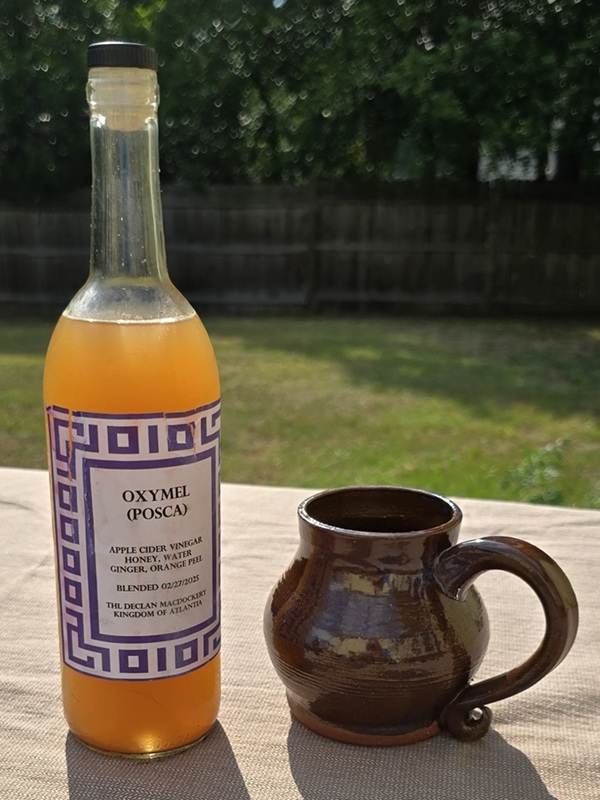
Oxymel, or posca, is a drink made from vinegar, honey, water, and spices. This is a very old beverage, dating back thousands of years, sometimes used for medicinal purposes, specifically respiratory ailments, but also used for eye ailments and wound wash. As a drink, oxymel was called posca by the Romans, and was mostly consumed by soldiers and commoners.
In Part 1 of this project, I brewed a batch of the ‘El Diablo’ cider two years befor in order to make the cider vinegar (see previous Cider recipe). In Part 2, I used the cider and a vinegar mother to make apple cider vinegar (see previous Three Vinegars documentation). This, then, is Part 3 of the project, making Oxymel/Posca from the vinegar.
Background
There are many mentions of oxymel, or oxymelli, in history, from ancient Greece by Hippocrates, ca. 400 BCE., to Lucius Junius Moderatus Columella, in his De Re Rustica, who ca. 50 AD quoted Cato the Elder (234-149 BCE) as saying:
“Fit vinum ex aceto & melle quod oxymel vocaverunt voce Graecanica. Nam oξ(?) dicitur Graecis acetu & μίλ mel. Fit autem oxymel hoc modo. Mellis decem librae cum aceti heminis quinque, haec decies subserve faciunt atque ita sinunt inveterare.“
“A wine made from vinegar and honey, which in Greece was called oxymel, (from Ancient Greek oξύ ‘acetu ‘ And μίλ ‘mel‘, hence [Latin] “oxymel”). It is made thus. Ten libras of honey (116 oz wt) with five heminas of vinegar (46 fluid oz), which will be subsumed.”
Oxymel was generally used for medicinal purposes, and was a simple syrup of vinegar and honey, perhaps with medicinal herbs, but without water. For instance, in the 1593 work Enchiridion chirurgicum, oxymel was recommended as part of a treatment for ophthalmia and other issues of the eye.
Another variant endemic to ancient Rome, called posca, was a ‘common drink for the common man’. In The Logistics of the Roman Army at War (264 B.C.-A.D. 235), Johnathan Roth discusses vinegar drink: “As with other foodstuffs of the common people, posca probably also featured in the Roman military diet…” (p. 38). Pliny the Elder mentions oxymel several times in his Historia Naturalis (Book XVIII, Chapters 28, 34, 57). It was likely that the vinegar used in Roman posca was wine vinegar.
According to Ann Hagen in her book Anglo-Saxon Food and Drink: Production, Processing, Distribution and Consumption, vinegar and honey were even drunk by the Anglo-Saxons, although “it was referred to as a ‘southern drink’” (231). It’s quite possible that the Romans brought posca north with them during the invasion of England.
Ingredients
My Materials:
3 cups Apple Cider Vinegar (my own)
1 cup Wildflower Honey (filtered)
10 cups Water
1 tbsp fresh ginger
2 tbsp sweet orange peel
Period Materials:
Vinegar (wine or fruit vinegar)
Honey (boiled and skimmed)
Water
Herbs/Spices (when available)
The Process
Since the Roman proportions I found during my reading seemed a bit too medicinal, and other periods weren’t specific on proportions at all, I took a recipe I found on a website of Romano-Britain reenactors (https://www.romanobritain.org/). The proportions seemed to be more like a soldier would drink on the fighting field. There was no reason to think that, given the ingredients, the Greeks, Romans or even Anglo Saxons would not add flavor in the form of spices to their posca.
The recipe I started from called for 4 c water, 1.5 c brewed red-wine vinegar, and .5 c honey. Since I wanted to use my own cider vinegar when I made the drink, I substituted apple cider vinegar. Then I doubled the recipe and decided to add fresh ginger and orange peel, both ingredients that Romans would have had available.
It should be noted that both Greek (oxymel) and Roman (posca) drinks would likely have been made from wine vinegar, since there are many more references to grapes and wine in both of those civilizations than cider vinegar. I had more cider vinegar at the time and since cider vinegar was more common by Anglo-Saxon period, I decided to use cider vinegar for this batch.
I heated 4 cups of water, added the ginger and 2 tbsp orange peel, and when the water was hot, dissolved the honey in. Then I mixed 3 c of vinegar with the other 4 c of water, and added the heated mixture. I found the vinegar was a bit too strong for my taste, and I couldn’t detect the orange, so I heated 2 more cups of water with 2 tbsp. orange peel, and let it steep, then mixed it into the drink.
Conclusion
Although oxymel/posca is not a drink I have made before, I enjoy the flavor. I plan to experiment with different herbs and spices in the future to see how they blend with the vinegar. I also plan to make a new batch of red wine vinegar and blend it with the honey and herbs to see what kind of interesting flavors I can achieve.
Also, I definitely prefer this drink chilled.
Bibliography
Hippocrates. The Genuine Works of Hippocrates. Ca. Translated by Charles Darwin Adams. New York: Dover, 1868. Hp. Acut. 16.
Dioscorides. De Materia Medica. 1st century CE
Roth, Jonathan. The Logistics of the Roman Army at War (264 B.C.-A.D. 235), Brill Publishers 1999, pp. 37-38.
Pliny the Elder (Gaius Plinius Secundus) Ca. 23/24–79 CE. Historia Naturalis, Book XXVIII. Translated by Dr. John Bostock. Accessed January 24, 2025. Ch. 28, 34, 57. https://www.perseus.tufts.edu/hopper/text?doc=Perseus%3Atext%3A1999.02.0137%3Abook%3D28.
Columella, Lucius Junius Moderatus. De Re Rustica: Of Husbandry, in Twelve Books: and his book, concerning Trees (ca. 50 BCE). Anonymous translator into English, with illustrations from Pliny, Cato, Varro, Palladius and other ancient and modern authors. London: Andrew Millar 1745, vol. 17
Antoine Chaumette, Enchiridion Chirurgicum Præter Tutissimam Chalmetei Practicen Brevem Externoram Affectuum Theoriam Complectens, Vol. 4: Ad H c Accessit Luis Venerea … Hoc Compendio Desideraret, Latin ed. (Independently published, 2018).
Wikipedia contributors. “Oxymel.” Wikipedia, The Free Encyclopedia. Accessed January 24, 2025. https://en.wikipedia.org/wiki/Oxymel.
Herbal Academy. “How to Make an Oxymel.” Herbal Academy Blog. Accessed January 24, 2025. https://theherbalacademy.com/blog/how-to-make-an-oxymel/.
Mountain Rose Herbs. “Herbal Oxymels.” Mountain Rose Herbs Blog. Accessed January 27, 2025. https://blog.mountainroseherbs.com/herbal-oxymels.
The Romans in Britain. “Recipe for Posca.” Accessed January 27, 2025. https://www.romanobritain.org/2-arl_food/arl_roman_recipes-posca.php.